
What is the house edge?
The house edge is the percentage of each bet that a casino expects to keep over the long run. It comes from paying winners slightly less than the true odds. A 2.70% edge means an average loss of RM 2.70 per RM 100 wagered.
Casinos do not need to cheat to profit. They set payouts a little below true odds, and the gap is the edge. Take a coin flip with true odds of 1 to 1. If a casino paid only 0.95 to 1 on a winner, it would keep a 2.5% edge on a fair coin.
The edge is a long-run average across many bets. It says nothing about the next spin, hand or roll. In a short session, luck dominates, and a player can finish well ahead. Over thousands of bets, results converge towards the figure.
House edge and return to player are two views of the same fact. If you want the slot angle, read what RTP means. The rest of this page focuses on table games and other bets.
House edge table for common bets
European roulette carries 2.70% on every bet, American roulette 5.26%, blackjack with basic strategy about 0.5%, baccarat banker 1.06%, player 1.24% and tie 14.36%, sic bo big and small 2.78%, and the craps pass line 1.41%.
| Game and bet | House edge | RTP |
|---|---|---|
| European roulette (single zero), any bet | 2.70% | 97.30% |
| French roulette, even-money bets with La Partage | 1.35% | 98.65% |
| American roulette (double zero), most bets | 5.26% | 94.74% |
| American roulette, top line (0, 00, 1, 2, 3) | 7.89% | 92.11% |
| Blackjack, basic strategy, common rules | about 0.5% | about 99.5% |
| Baccarat, banker (5% commission) | 1.06% | 98.94% |
| Baccarat, player | 1.24% | 98.76% |
| Baccarat, tie (pays 8 to 1) | 14.36% | 85.64% |
| Sic bo, big or small | 2.78% | 97.22% |
| Sic bo, single number | 7.87% | 92.13% |
| Sic bo, any triple | 13.89% | 86.11% |
| Craps, pass line | 1.41% | 98.59% |
| Craps, don't pass | 1.36% | 98.64% |
| Craps, free odds behind the line | 0% | 100% |
The figures are the standard published results of the underlying probability. Blackjack varies with rules, so treat the 0.5% as a typical figure. Always read the rules on the table.
Slots do not fit this table, because each title has its own setting. Most online slots have edges between 2% and 8%. Our slots hub explains the different types.
How the numbers are calculated
You can check any of these figures yourself. The method is the same each time: multiply each outcome by its probability, then sum.
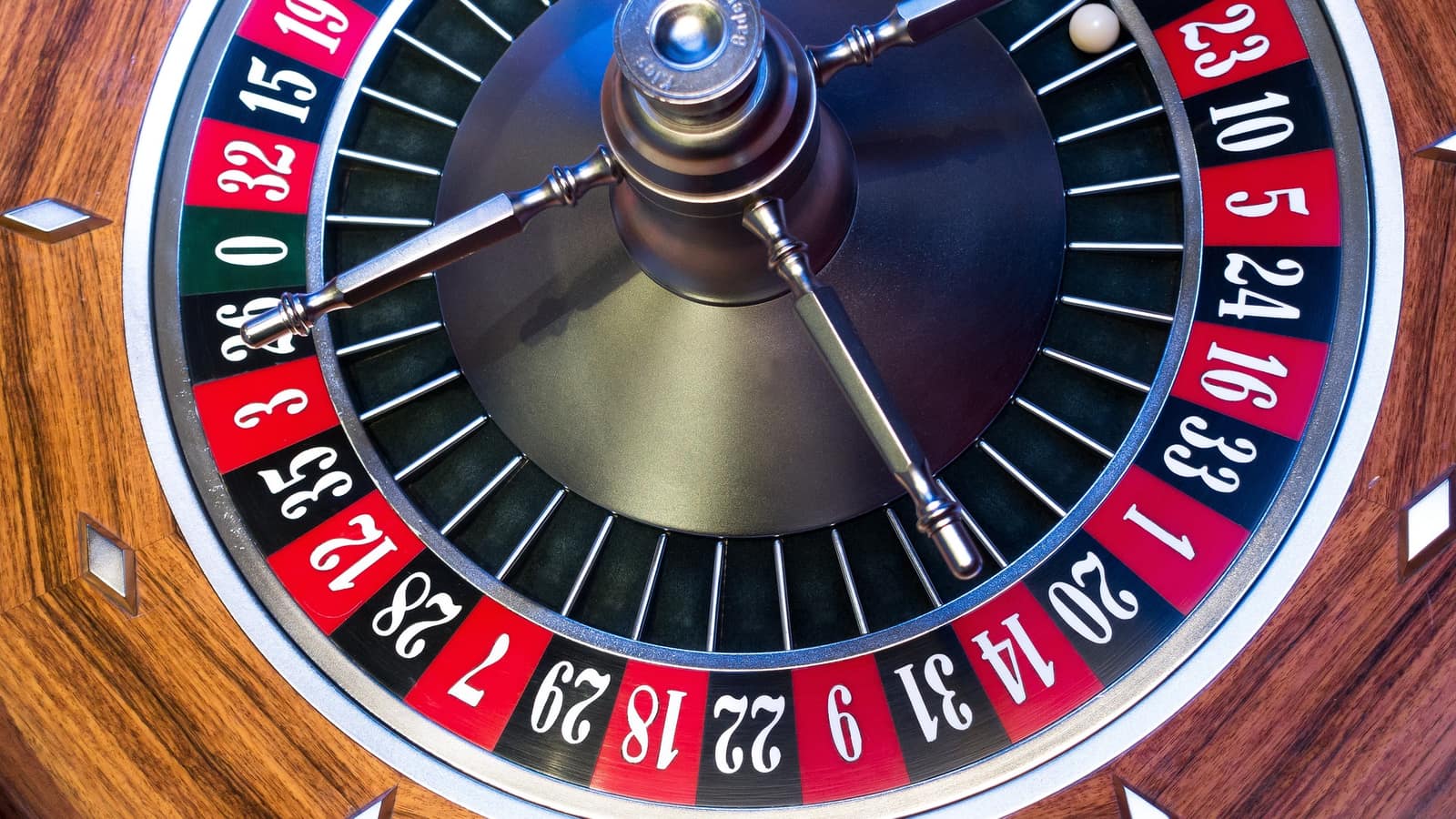
Roulette: why the extra zero matters
A European wheel has 37 pockets (1 to 36 plus a single zero). A straight-up bet on one number pays 35 to 1.
- You win with probability 1/37 and gain 35 units.
- You lose with probability 36/37 and lose 1 unit.
Expected result per unit = (1 × 35 + 36 × −1) ÷ 37 = −1/37 = −2.70%.
An American wheel has 38 pockets, because it adds a double zero. The payout stays at 35 to 1, so the result is −2/38 = −5.26%. That is nearly double the cost for the same bet. If both wheels are on offer, always pick the single-zero one. Our roulette page lists the variants.
French roulette goes further with the La Partage rule. On even-money bets, a zero returns half your stake, which halves the edge to 1.35%.
Baccarat: the banker's commission
In an eight-deck game, the banker wins about 45.86% of hands, the player about 44.62%, and ties occur about 9.52%.
- Banker bet (win pays 0.95 after a 5% commission): 0.4586 × 0.95 − 0.4462 = −0.0105, or about 1.06% with unrounded probabilities.
- Player bet (pays 1 to 1): 0.4462 − 0.4586 = −0.0124, or 1.24%.
- Tie bet (pays 8 to 1): 0.0952 × 8 − 0.9048 = −0.1432, or about 14.36% with unrounded probabilities.
The banker bet is cheapest even after commission. The tie bet is one of the worst in the casino, despite its large payout. See our baccarat page and baccarat strategy guide.
Sic bo: why triples hurt big and small
Three dice give 216 outcomes. Big wins on totals of 11 to 17 unless the dice show a triple. That covers 105 outcomes. Small works the same way for totals of 4 to 10, also 105 outcomes.
Expected result = (105 − 111) ÷ 216 = −6/216 = −2.78%.
The triple rule takes the player's side from 108 winning outcomes to 105, and that three-outcome gap is the whole edge. Our sic bo guide covers the other bets.
Craps: the pass line
The pass line wins on a 7 or 11 at the come-out, or when the point repeats before a 7. The total probability of winning is 244/495, or 49.29%. The edge is (244 − 251) ÷ 495 = −7/495 = −1.41%.
The free odds bet behind the pass line is paid at true odds, so it carries no edge. Casinos limit how much you can take, usually as a multiple of your line bet.
Blackjack: skill changes the number
Blackjack is the one major table game where your choices move the edge. A typical six-deck game paying 3 to 2 on blackjack has an edge of around 0.5% if you follow basic strategy. If you guess your decisions, the edge can rise to 2% or more. Rule changes also matter: a table paying 6 to 5 for blackjack instead of 3 to 2 adds roughly 1.4 percentage points to the edge. Look at our blackjack page and basic strategy guide for the rules that matter.
What the house edge costs per hour
Expected hourly cost equals bets per hour × average bet × house edge. At 40 spins an hour and RM 50 a spin, European roulette costs about RM 54 an hour, while American roulette costs about RM 105. Speed doubles the cost.
The percentage alone hides how fast money moves. The cost per hour depends on how many bets you place. Use this formula:
Expected hourly cost = bets per hour × average bet × house edge
The table below uses illustrative speeds and a RM 50 average bet. Real speeds vary by table and by RNG or live format.
| Bet | Bets per hour | Total wagered | House edge | Expected cost per hour |
|---|---|---|---|---|
| European roulette | 40 | RM 2,000 | 2.70% | RM 54 |
| American roulette | 40 | RM 2,000 | 5.26% | RM 105 |
| Blackjack (basic strategy) | 60 | RM 3,000 | 0.5% | RM 15 |
| Baccarat, banker | 70 | RM 3,500 | 1.06% | RM 37 |
| Baccarat, tie | 70 | RM 3,500 | 14.36% | RM 503 |
| Sic bo, big or small | 60 | RM 3,000 | 2.78% | RM 83 |
| Craps, pass line | 50 | RM 2,500 | 1.41% | RM 35 |
Two lessons stand out. A game with a small edge can still cost more per hour if it is fast, because more bets pass through. And the tie bet in baccarat costs nearly 14 times the banker bet per hour, though both sit at the same table.
To convert the same logic to pounds, replace RM with £. A £10 bet at 40 spins an hour on European roulette costs £400 × 2.70% = £10.80 an hour on average. On American roulette, it is £21.04.
House edge and bonuses
The house edge decides what clearing a bonus really costs. Multiply the total amount you must wager by the edge of the game you play. A RM 6,000 wagering requirement on a 4% slot costs RM 240 in expectation. The same requirement through European roulette would cost RM 162, but roulette usually counts for little or nothing toward wagering. Our guide to wagering requirements works through this in MYR, GBP and USD.
Common misconceptions about the house edge
- "A betting system beats the edge." Systems change the pattern of wins and losses, but every bet still carries the same edge. A Martingale player simply risks a large loss for a small gain.
- "The edge is a fee on my deposit." It applies to total turnover. Playing slowly and with small stakes reduces the cost.
- "Red is safer than a single number." On roulette, every bet has the same edge. Even-money bets lose less often, but they win less per hit.
- "A casino can switch the edge when I win." Certified games run fixed maths, checked by labs such as eCOGRA. Be wary of casinos without clear provider names, as our guide on how to choose a casino explains.
How to pick games using the house edge
Start with the edge, then add what you enjoy. If your priority is the lowest cost per hour, choose blackjack with basic strategy, or baccarat banker, or craps pass line with odds. If you prefer roulette, play the single-zero or French version. Skip tie bets, American top line, and any side bet whose payout is not clear.
Always check the payout table before you sit down, because the same game can run on different rules. For wider reading on the concept, see the house advantage entry on Wikipedia.
Even the lowest-edge game still costs money over time. Treat it as the price of entertainment, set limits before you play, and take breaks. Free support is available from BeGambleAware and on our responsible gambling page.
Frequently asked questions
What is a good house edge?
Lower is better for you. Under 1% is excellent, and only a few bets reach it, such as banker in baccarat (1.06%) or blackjack with basic strategy (about 0.5%). European roulette at 2.70% is moderate. Anything above 5%, such as American roulette or many slot settings, is expensive.
Does the house edge mean I will lose that percentage of my deposit?
No. The edge applies to the total amount you wager, not your deposit. If you bet RM 100 many times and wager RM 5,000 in total at a 2.70% edge, the expected loss is RM 135. Fast play multiplies the cost, because each bet carries the edge again.
Can I beat the house edge?
Not with any betting system. Progression plans like Martingale change how wins and losses are spread, but not the average loss per unit wagered. Skill reduces the edge in blackjack and video poker, where correct play matters. In roulette, baccarat and slots, nothing you do changes the edge.
Which casino game has the lowest house edge?
Blackjack with perfect basic strategy has among the lowest, at roughly 0.5% depending on the rules. Pass line and odds bets in craps can fall below 1%, and baccarat banker is about 1.06%. Rules vary, so check the table's payout for blackjack and the zero count in roulette.
Is house edge the same as RTP?
They mirror each other. House edge equals 100% minus RTP. A game with a 2.70% edge has a 97.30% RTP. Slots tend to quote RTP, and table games tend to quote edge. Our RTP guide covers slots in more detail.