Poker hand rankings from highest to lowest
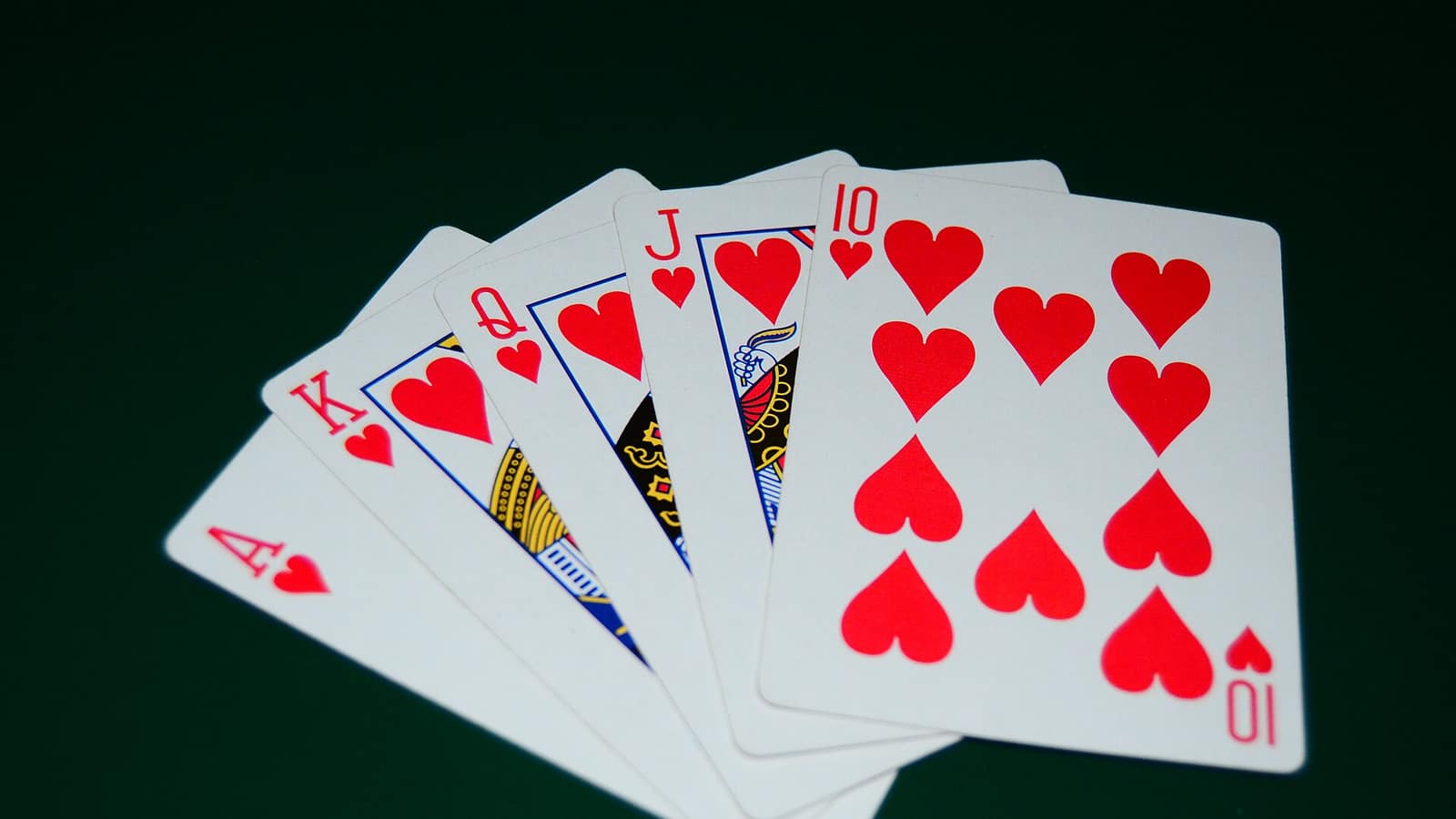
Poker hand rankings run, from best to worst, as follows: royal flush, straight flush, four of a kind, full house, flush, straight, three of a kind, two pair, one pair and high card. The rarer a five-card hand is, the higher it ranks.
Almost every poker game, from Texas Hold'em to Casino Hold'em, uses this same order. You build your best five-card hand from the cards available to you, and the highest rank takes the pot. When two players hold the same rank, the cards inside the hand break the tie.
The table below lists the ten hands, their counts and their chances. Every figure comes from counting the 2,598,960 possible five-card hands in a 52-card deck.
Five-card poker hand rankings with odds
| Rank | Hand | Example | Combinations | Chance | Odds (1 in) |
|---|---|---|---|---|---|
| 1 | Royal flush | A K Q J 10, same suit | 4 | 0.00015% | 649,740 |
| 2 | Straight flush | 9 8 7 6 5, same suit | 36 | 0.0014% | 72,193 |
| 3 | Four of a kind | 8 8 8 8 K | 624 | 0.024% | 4,165 |
| 4 | Full house | J J J 4 4 | 3,744 | 0.144% | 694 |
| 5 | Flush | A J 8 5 3, same suit | 5,108 | 0.197% | 509 |
| 6 | Straight | 10 9 8 7 6, mixed suits | 10,200 | 0.392% | 255 |
| 7 | Three of a kind | 7 7 7 K 2 | 54,912 | 2.11% | 47 |
| 8 | Two pair | Q Q 5 5 9 | 123,552 | 4.75% | 21 |
| 9 | One pair | 10 10 A 6 3 | 1,098,240 | 42.26% | 2.4 |
| 10 | High card | A J 8 6 3, mixed suits | 1,302,540 | 50.12% | 2.0 |
The flush and straight counts exclude straight flushes, so no hand is counted twice. Over half of all five-card hands contain nothing better than a high card. Those numbers explain why even a modest pair is a decent holding in many games.
How each poker hand works
Royal flush. Ace, king, queen, jack and ten, all of the same suit. It is the best hand and cannot be beaten, though several players can tie in games with community cards.
Straight flush. Five cards in sequence, all of one suit. The highest top card wins, so K-Q-J-10-9 beats 9-8-7-6-5.
Four of a kind. Four cards of the same rank, plus a kicker. Higher quads win, and the kicker breaks ties when the quads are shared.
Full house. Three cards of one rank and two of another. The three-card rank is compared first, so 9-9-9-2-2 beats 8-8-8-A-A.
Flush. Five cards of one suit, not in sequence. The highest card decides, then the next, and so on down.
Straight. Five cards in sequence of mixed suits. The ace can sit high or low, but a straight cannot wrap around.
Three of a kind. Three cards of one rank plus two unrelated cards. Also called trips or a set.
Two pair. Two cards of one rank, two of another and a kicker. Compare the higher pair first, then the lower, then the kicker.
One pair. Two cards of the same rank plus three kickers.
High card. Anything else. The highest card plays, then the second highest and so on.
Kickers and ties
Kickers are the leftover cards that decide between hands of the same rank. If two players each hold a pair of aces, the one with the higher fifth card wins. The suits never decide anything in standard poker. If every card matches in rank, the pot splits.
For example, you hold A-K and the board shows A-9-5-4-2, so your best hand is a pair of aces with a king kicker. Another player with A-Q has the same pair with a queen kicker. You win with the better kicker.
Also, you play the best five cards only. A sixth or seventh card never helps you, except by improving the best five.
Poker hand rankings in Casino Hold'em
Casino Hold'em is a house-banked version of Texas Hold'em. You play against the dealer, not other players, and the standard five-card order above applies in full.
Here is how a round runs. You place an ante and receive two cards, then see a three-card flop. You can fold, or make a raise equal to twice the ante. The dealer then reveals the turn and river, and shows a hand. The dealer needs a pair of fours or better to qualify.
However, your ante pays 1:1 on most wins, with a bonus on strong hands. The raise pays 1:1. A common ante paytable pays 100:1 for a royal flush, 20:1 for a straight flush, 10:1 for four of a kind, 3:1 for a full house and 2:1 for a flush. The house edge on the ante bet is about 2.2% with correct play.
Three Card Poker rankings
Three Card Poker uses a short three-card hand, which changes the order. Because a flush is easier to make with three cards than three of a kind, the rankings are rearranged.
| Rank | Hand | Combinations | Chance |
|---|---|---|---|
| 1 | Straight flush | 48 | 0.22% |
| 2 | Three of a kind | 52 | 0.24% |
| 3 | Straight | 720 | 3.26% |
| 4 | Flush | 1,096 | 4.96% |
| 5 | One pair | 3,744 | 16.94% |
| 6 | High card | 16,440 | 74.39% |
There are 22,100 possible three-card hands. Note that a straight beats a flush here, the reverse of the five-card order. The dealer qualifies with queen-high or better.
The main game is Ante and Play, with a house edge of about 3.4% per ante. The popular Pair Plus side bet pays out on a pair or better, regardless of what the dealer holds. With a standard paytable, its edge is around 2.3%.
Video poker and the poker hand rankings
Video poker is a solo game on a screen. You are dealt five cards, you choose which to hold, and the rest are replaced once. Your final hand is paid by a paytable, using the standard five-card order.
The paytable is what matters. In Jacks or Better, a pair of jacks or higher is the minimum paying hand. The best-known version pays 9 coins for a full house and 6 for a flush per coin staked. Called "9/6", it returns about 99.54% with perfect play.
Other versions change the maths. Deuces Wild treats all twos as wilds, which raises the value of four of a kind and five of a kind. Full-pay versions can return close to 100% or just above, while short-pay machines are much worse. Always compare the full paytable, and look at our what is RTP page to see how return figures work.
How the rankings help your strategy
First, knowing the order is the foundation, but the odds table is what shapes decisions. A pair or better appears in under half of all hands, so starting with a high pair is a strong position. A flush draw with four suited cards will complete only about 19% of the time on one draw.
So in casino games, rankings drive paytables rather than opponents' bets. That means the maths is fixed. Learn which hands pay and how often, then pick the variant with the lowest edge. For a broader view of what each table game costs, see our online casino games hub and the casino poker hub.
Quick reference for poker hand rankings
- Royal flush beats straight flush, which beats four of a kind.
- A full house beats a flush, and a flush beats a straight.
- Three of a kind beats two pair, which beats one pair.
- Suits never rank against each other in standard play.
- In Three Card Poker, three of a kind beats a straight, and a straight beats a flush.
For more on the standard hand order, see the Wikipedia list of poker hands. When you are ready to play, browse our casino reviews to see which operators carry live and video poker. If it stops being fun, GamCare offers free help.
Frequently asked questions
What is the highest hand in poker?
The royal flush is the best hand in standard poker. It is a straight flush from ten to ace in one suit, such as A-K-Q-J-10 of hearts. Only four exist in a 52-card deck, so you will see one roughly once in every 650,000 five-card hands. Next come the straight flush, then four of a kind.
Does a flush beat a straight?
Yes. A flush, with five cards of one suit, outranks a straight, which is five cards in sequence. The reason is rarity. A flush appears about once in every 509 hands, while a straight appears about once in every 255. Rarer hands rank higher in the standard order.
How are ties broken in poker?
Ties are broken first by the rank of the main cards in the hand, then by kickers, which are the remaining cards. For example, a pair of kings with an ace kicker beats a pair of kings with a queen kicker. Suits never break ties in standard poker, so identical ranks split the pot.
Is an ace high or low in a straight?
An ace can be either. A-K-Q-J-10 is the highest straight, and A-2-3-4-5, called the wheel, is the lowest. Wrapping around is not allowed, so Q-K-A-2-3 is not a straight. Check Three Card Poker and video poker paytables, because some games treat these slightly differently.
Do Three Card Poker hands rank the same as five-card hands?
Not quite. With only three cards, a three of a kind is harder to make than a straight or a flush, so it ranks higher than both. The order runs straight flush, three of a kind, straight, flush, pair, high card. There are no full houses or four of a kind.
Which casino poker game has the lowest house edge?
Full-pay video poker, such as 9/6 Jacks or Better, returns about 99.54% with perfect play, a house edge of roughly 0.46%. Casino Hold'em costs about 2.2% on the ante, and Three Card Poker about 3.4% on ante-play. Check our house edge guide for more comparisons.